
A pedra angular do nosso sucesso
In the field of elevator engineering, there has long been a common question regarding guide rail selection: must high-speed elevators use solid guide rails? This issue not only concerns elevator safety but also directly affects project costs and procurement decisions.
To answer this question, it is first necessary to clarify two concepts: what a high-speed elevator is and what a solid guide rail is.
Definition of high-speed elevator: A high-speed elevator is generally defined as a vertical lift with a rated speed greater than 2.5 m/s and not exceeding 6.0 m/s. Elevators with speeds exceeding 6.0 m/s are referred to as super-high-speed elevators. They are mainly used in skyscrapers and ultra-high-rise buildings.
Function of guide rails: Elevator guide rails are safety tracks installed on the hoistway walls, guiding the car and the counterweight. In addition to guiding, they must withstand impact forces during car movement, braking forces during deceleration, and the enormous impact forces generated when the safety gear activates in an emergency. The magnitude of these forces is directly related to the elevator’s load capacity and speed.
|
Comparison Aspect |
Solid Guide Rail |
Hollow Guide Rail |
|
Manufacturing process |
Machined (mechanical processing) |
Cold‑roll formed |
|
Flexural rigidity of cross‑section |
High – solid, monolithic structure resists deformation |
Relatively low – hollow section is prone to elastic deflection |
|
Precision grade |
High precision (guide face tolerance up to 0.05 mm) |
General precision |
|
Continuous fatigue resistance |
Excellent |
Moderate |
|
Primary application |
Car guidance (main rail); also used for counterweight in some cases |
Counterweight guidance (secondary rail) |
|
Rigidity |
High |
Relatively low |
|
Weight |
Heavier |
Lighter |
|
Cost |
Higher |
Lower |
When a high-speed elevator overspeeds, the safety gear instantly clamps onto the guide rail, generating impact loads several times the rated load. A solid guide rail, being dense and integral, offers high bending and compressive strength and does not collapse or deform under clamping.
In contrast, hollow guide rails have thin-walled hollow structures that are prone to tearing and crushing under concentrated impact forces.
At speeds of 2.5 m/s and above, hoistway wind pressure and inertial forces during acceleration and deceleration produce continuous lateral thrust. Solid guide rails, with their large cross-sectional stiffness, effectively limit the car’s sway amplitude, preventing vibration and resonance.
Hollow guide rails, being more flexible, are prone to elastic deformation at high speeds, which significantly degrades car stability and fails to meet ride comfort standards.
Solid guide rails are precision-ground, with extremely tight tolerances on straightness and joint flatness. When locked together with solid connection plates, the joints are seamless.
Hollow guide rails, limited by cold-roll forming accuracy, tend to produce steps at splices, which generate abnormal noise and uneven guide-shoe wear at high speeds, making them unsuitable for premium office buildings or hospital elevators where quiet and smooth operation is essential.
Ultra-high-speed elevators in skyscrapers experience frequent daily start-stop cycles, subjecting guide rails to alternating cyclic stresses. Solid guide rails have continuous metal flow lines and, after proper heat treatment, offer excellent fatigue resistance.
Hollow guide rails have welds that are stress concentration points, prone to cracking and deformation under long-term high-speed loading, leading to high maintenance and replacement costs later, making their overall economy far inferior to that of solid guide rails.
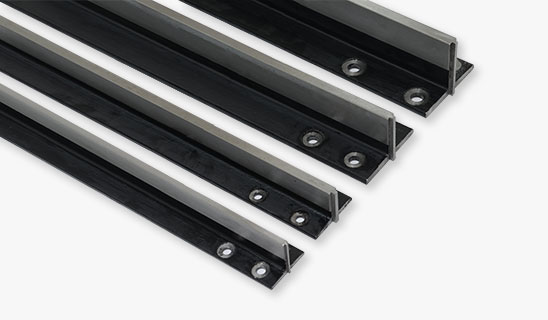 The Role of Hollow Guide Rails in High-Speed Elevators
Hollow guide rails are not entirely without use in high-speed elevators. An elevator typically uses four guide rails – two car guide rails (main rails) and two counterweight guide rails (secondary rails). In practice, the car guide rails of high-speed elevators are almost exclusively solid, and usually of large specifications. However, the counterweight guide rails can often be hollow.
Hollow guide rails offer the advantages of lighter weight and lower cost. As long as they meet the counterweight guidance requirements, they can significantly reduce both cost and hoistway load. In some medium-to-high-speed systems, hollow guide rails are even widely adopted because, with the same amount of steel, their hollow cross-section provides greater bending moment of inertia and less vibration during dynamic operation.
Therefore, the car guide rails of a high-speed elevator must be solid, while the counterweight guide rails may be hollow depending on the working conditions.